
Louisa Jail VINE Coverage
Virginia Jail VINE is the applicable notification channel for a person held at Central Virginia Regional Jail. CVRJ serves Louisa even though the facility is in Orange. The service can carry jail custody information and events such as release, transfer, escape or recapture, and death. Anyone may view Jail VINE offender information and register for jail notifications under Virginia's published workflow.
VINE is not the custodian of the underlying jail record. CVRJ controls its booking and release entry, including the disposition or receiving agency. A Louisa court controls the order and case disposition. If VINE reports a custody change, use those sources to determine what occurred. Optional alerts for work release or home electronic monitoring were not confirmed for CVRJ and should not be assumed.
The CVRJ home page identifies Louisa in the regional jail's service area and provides a VINE route.
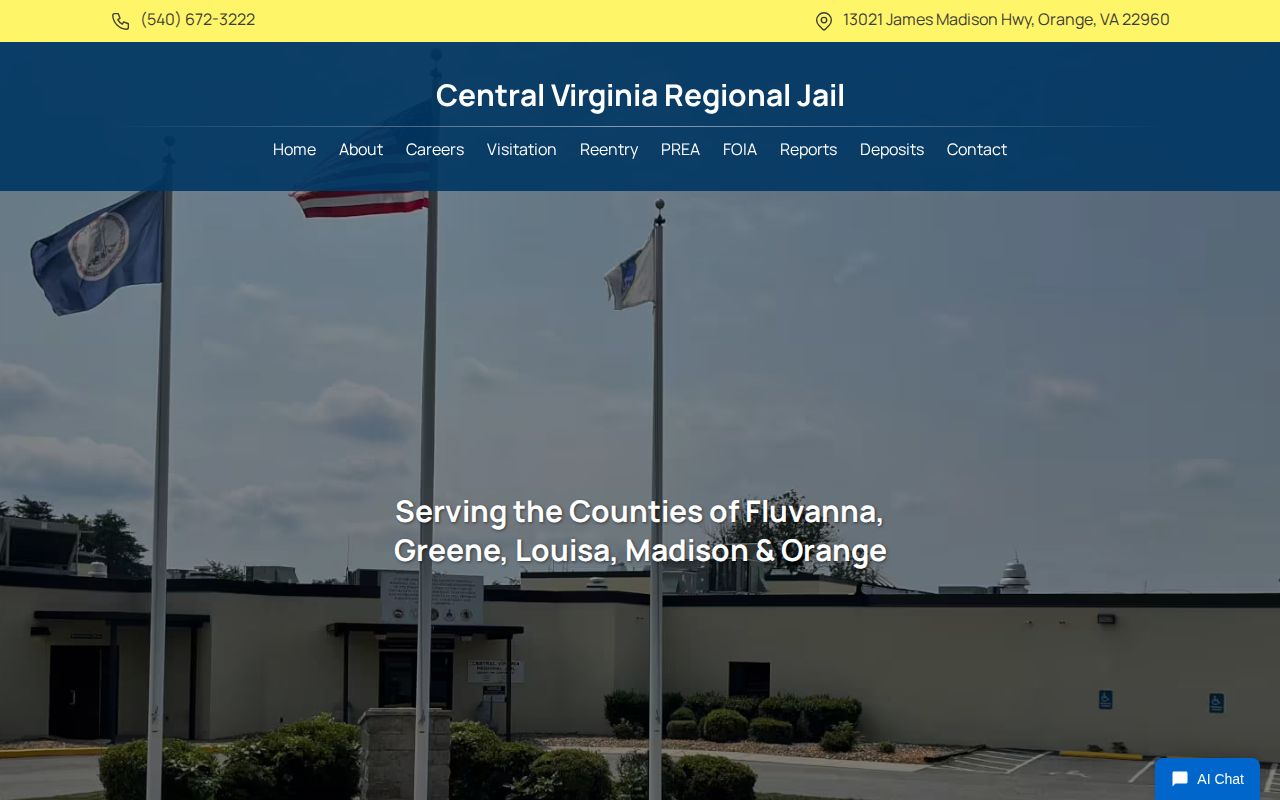
The captured panel links the Louisa custody context to the correct jail notification system. It does not represent a public list of everyone released.
Search a Louisa Inmate
Use the official Virginia portal for a specific person. Names and identifiers must be compared with care because a common name can return more than one match. The facility is a key clue. A CVRJ record concerns the regional-jail episode, while a VADOC facility or community-corrections location belongs to the state system.
- Open Virginia VINE and confirm that Virginia is the selected state.
- Choose the custody or offender search and enter the person's name or offender ID.
- Review all likely matches. Compare the displayed identifiers and facility before opening a record.
- Read the live custody status and event wording without changing “released or transferred” into community release.
- Save the as-of time and call CVRJ if the result concerns a Louisa jail booking.
The telephone search and notification alternative is 1-800-467-4943, with TTY at 1-866-847-1298. A no-result response is unresolved. Spelling, aliases, record aging, transfer, source coverage, and update lag can all affect the search. For a full chain across the jail, courts, and corrections systems, use the Louisa County released-inmate lookup.
The Virginia VINE search screen is the official starting point.
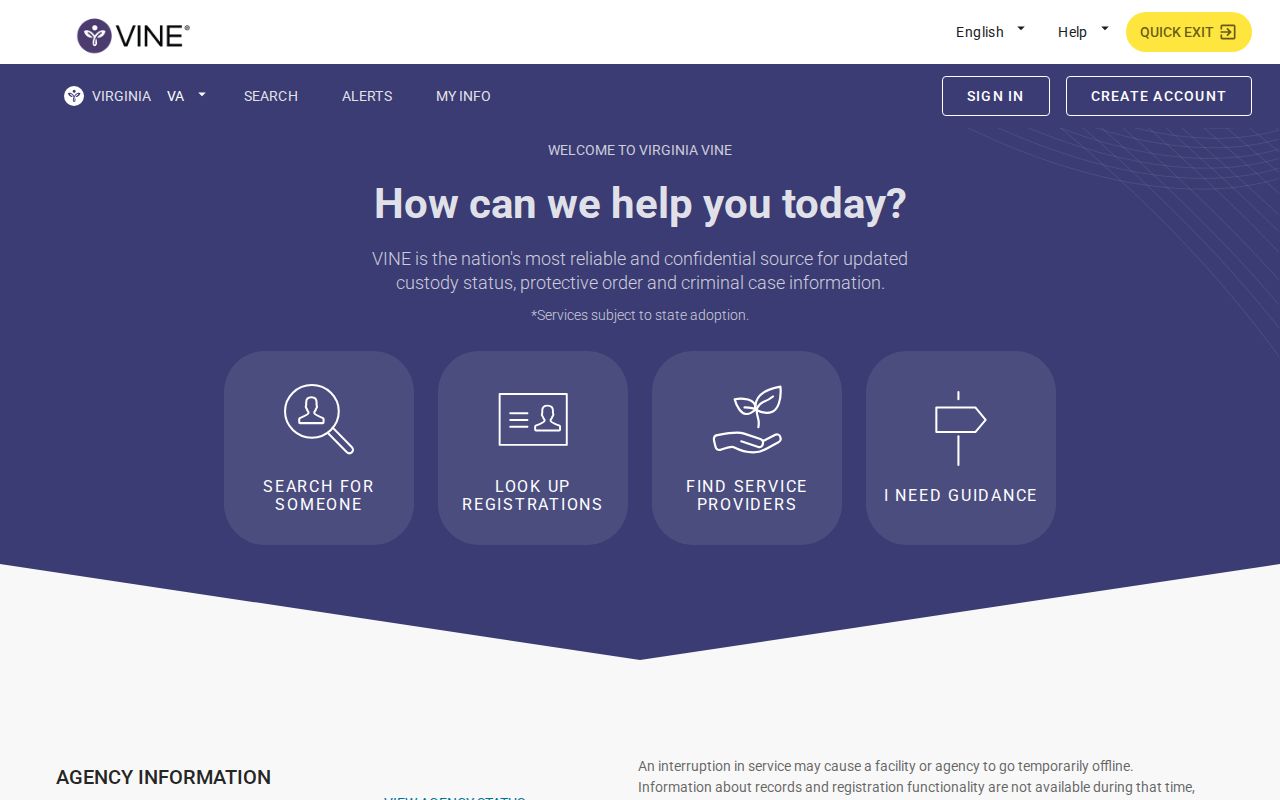
The state screen shows where a person-specific search begins. A lawful match must still be checked against the facility and source agency.
Read Louisa VINE Results
The live result controls the exact fields and labels. Virginia's official materials establish the supported event workflow, but they do not promise a permanent “Released” profile or the same data on every record. Use the result to identify a likely custody change, then reconcile exact timing and disposition with CVRJ.
| Result field | What it can mean |
|---|---|
| Name or offender ID | Helps distinguish the specific record from similar names. |
| Facility | Identifies the jail or source tied to the reported custody event. |
| Custody status | Reports the source agency's current status as displayed at the time checked. |
| Release or transfer event | Signals that the reported custody changed, but may not mean community release. |
| Event date | Supplies the posted timing, which should be checked against the agency record. |
| Notification controls | Shows the alert channels offered for that person and system. |
“Released or transferred” is deliberately broad. The person might leave CVRJ on bond, finish a local sentence, move to VADOC, enter another jail, or be picked up by another authority. Call CVRJ and ask for the release type or destination. If the jail reports VADOC transfer, allow intake time and search the state locator.
Register Louisa Release Alerts
Registration begins only after the correct person has been selected. The official materials describe telephone, text, email, and TTY routes as available options, though the live screen determines what is offered for a given record. Registration is free. Keep the contact current and follow the on-screen confirmation for the chosen channel.
- Open the correct person's record and choose the alert or notification control.
- Select an available channel, such as telephone, text, email, or TTY.
- Enter the destination accurately and complete the confirmation shown on screen.
- For a telephone alert, create a personal identification number, or PIN.
- When an automated call arrives, enter the PIN to acknowledge it and stop repeat calls.
- After a transfer, check whether registration is needed in the receiving system.
The PIN step applies to telephone notifications. Do not assume email and text use the same phone-PIN workflow. An alert is a prompt to verify. It should not be the only source used for plans that depend on the person's actual location or the exact time of release.
Note: Save the registration details privately and revisit them after any transfer because notification enrollment does not automatically follow every custody system.
Confirm Louisa VINE Events
For a CVRJ event, call the regional jail at (540) 672-3222 and ask whether the named booking ended through community release or transfer. Request the existing release entry when exact time and type matter. Then read the Louisa General District or Circuit Court case for the legal basis. A bond, dismissal, or sentence order does not prove physical release if another hold remained.
Use the VADOC locator only when state custody or supervision is plausible. An institutional location means secure state custody continues. A probation or parole district can mean the person is in the community but still under state supervision. A missing former state record is not a lifelong discharge history, so VADOC records may be needed.
Jail VINE does not cover BOP or ICE. A federal prisoner may require the BOP locator, federal court, holding facility, or U.S. Marshals records path. An immigration handoff requires CVRJ's destination field and the ICE locator where applicable. Both are transfers unless the receiving record shows otherwise.
Three Virginia Alert Systems
Virginia requires separate registration across real custody and legal boundaries. Jail VINE covers participating local and regional jails, including the CVRJ context. VADOC's Notification and Assistance for Victim Inclusion program, known as NAAVI, serves qualifying victims in state custody matters. The Virginia State Police registry provides a separate tracking feature for people who are legally required to register for covered offenses.
| System | Purpose and boundary |
|---|---|
| Virginia Jail VINE | Specific-person jail custody events and alerts from participating local or regional facilities. |
| VADOC NAAVI | Qualifying-victim notices for state custody, transfer, anticipated or actual release, parole activity, and related events. |
| State Police registry tracking | Address-change tracking for people legally subject to the separate registry, not a general inmate service. |
Registration in one does not enroll a person in the others. Virginia materials say a sentence under 12 months generally remains with Jail VINE, while a sentence of 12 months or more calls for VADOC victim-notification registration. Some state-responsible people remain physically in a jail while VADOC calculates the date. A qualifying victim may then need both systems because physical location and sentence administration differ.
This separation is angle N's key Louisa point. A jail alert may announce “released or transferred” just as the person enters VADOC responsibility. The alert boundary mirrors the custody boundary. Confirm the move and register with the new program when eligible rather than expecting the old jail enrollment to continue.
Virginia's workflow gives a sentence-length guide for that transition. A sentence under 12 months generally remains with Jail VINE. A sentence of 12 months or more calls for VADOC victim-notification registration. Some state-responsible people serving under two years can remain in a local or regional jail while VADOC calculates the release date. As a result, the building shown in a search and the agency administering the sentence may differ. Ask which agency owns the custody event before selecting the next alert system.
Louisa State Notification Options
NAAVI is not a second public offender locator. VADOC Victim Services administers it for qualifying victims. Published events can include transfer, anticipated release, actual release, parole activity, work release, escape or recapture, and death. VADOC says anticipated release notice is typically sent about 30 days ahead. Notices stop after release, so the program is not a historical discharge archive.
Victim Services can be reached at 1-800-560-4292 or (804) 674-3243, by email at victimservices@vadoc.virginia.gov, or by mail at P.O. Box 26963, Richmond, VA 23261. Listed service hours are weekdays from 8:30 a.m. to 5 p.m. Eligibility and enrollment should be confirmed with the office.
The Virginia State Police registry applies only to people legally required to register. Its public tracking can provide email notice when a selected registrant's address changes. Registry presence is not a release date, a jail list, or proof of current custody. Use VINE, CVRJ, VADOC, and the court for the custody event itself.
A VADOC locator result serves another purpose. It can identify a state prison or a probation and parole office when a person is incarcerated or under community supervision. Release-date information appears only when available, and a future date is not proof of completed discharge. Fully discharged people may disappear from the locator. NAAVI supplies notices to eligible registered victims, while the locator supplies a public status lead. Neither one replaces CVRJ's record of a Louisa jail transfer.
Note: Match the alert program to the current custodian and legal coverage; no single Virginia enrollment follows every person for life.